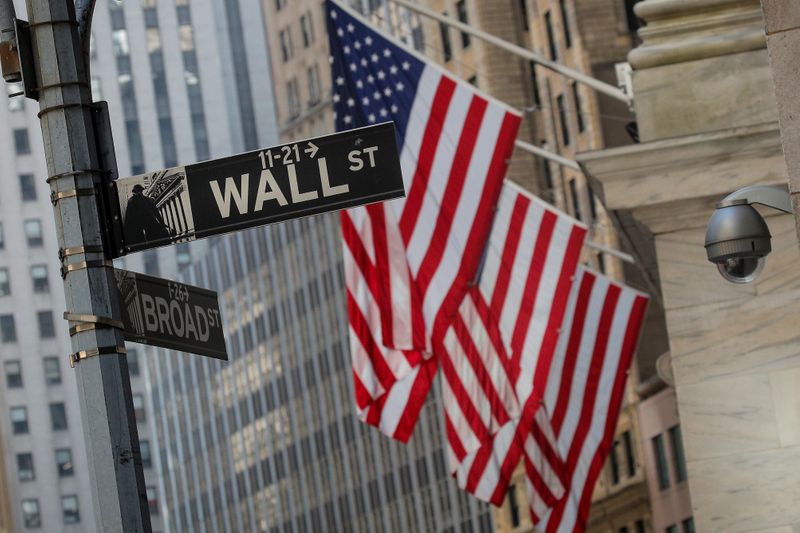
S&P 500 tops 5,800 for first time ever as Wall Street banks kick off earnings
The S&P 500 rose Friday, climbing above the 5,800 mark for the first time as JPMorgan led a string of mostly better than expected earnings,
At 12:51 p.m. ET (1651 GMT), the Dow Jones Industrial Average rose 266 points, or 0.6%, while the S&P 500 index climbed 0.2% to 5,803.48, and the NASDAQ Composite gained 0.2%.
All three major indexes are on track to notch their fifth consecutive week of gains - the best winning streak for the Dow in eight months and the best for the Nasdaq since May. JPMorgan Chase and Wells Fargo rise after earnings
The main focus Friday will be on the third quarter earnings season, with major financial companies getting the ball rolling. These results offer an important view into the economy, including the strength of demand for loans.
JPMorgan Chase (NYSE:JPM ) stock rose 4% after the largest US lender by assets topped quarterly estimates for profit and revenue on higher-than-expected net interest income.
Wells Fargo (NYSE:WFC ) stock also rose 6% after the bank reported third-quarter earnings that beat expectations, boosted by lower expenses and credit costs.
Goldman Sachs (NYSE:GS ), Bank of America (NYSE:BAC ) and Citigroup (NYSE:C ) will report earnings next week.
Elsewhere, Tesla (NASDAQ:TSLA ) stock fell more than 9% after the group unveiled its long-awaited "Cybercab" robotaxi, although analysts flagged that CEO Elon Musk provided few answers to crucial questions surrounding the technology.
By contrast, Uber (NYSE:UBER ) stock rose 5% after Tesla’s much-anticipated Robotaxi event failed to impress investors, with Jefferies saying, Tesla’s “toothless taxi is a best-case outcome for Uber.” PPI data supports smaller rate cut
The producer price index for September was unchanged last month versus August, easing from a prior reading of 0.2% and below expectations for an uptick of 0.1%.
Year-on-year, the index increased by 1.8%, slower than an upwardly revised mark of 1.9% in August, potentially pointing to a cooling inflation picture as lessening the impact of the consumer inflation data, released earlier in the week, which read stronger-than-expected.
Traders are now pricing in a major chance for a 25 basis point cut in November, instead of the 50-basis-point cut the Fed introduced in September.
Comments from Fed officials added to this notion, with Atlanta Fed President Raphael Bostic stating that the possibility of a hold in November could also be considered.
A slower pace of interest rate cuts potentially presents pressure on Wall Street, given that U.S. stock valuations scaled record highs on expectations of a sharp reduction in rates.
(Ambar Warrick contributed to this article.)
Source: Investing.com