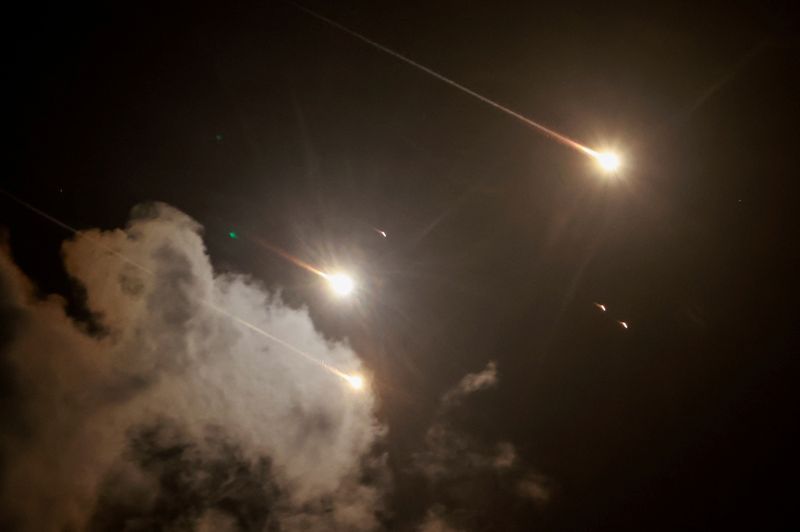
Analysis-Lessons from Iran missile attacks for defending against China's advanced arsenal
By Gerry Doyle
SINGAPORE (Reuters) - Iran's missile barrage this month against Israel, after a similar large-scale attack in April, shows the value, as well as the shortcomings, of U.S and allied missile defences in a potential Indo-Pacific conflict with China, analysts say.
Although differences between the two scenarios limit the lessons that can be learnt, the nearly 400 missiles of different types that Iran has fired at Israel this year offer the United States and China some idea of what works and what does not.
For Washington, the main takeaway from Iran's Oct. 1 attacks - the largest sample yet of ballistic missiles fired against modern defences - could be that Beijing's missiles would be more difficult to intercept than Iran's and that the ability to strike back would be needed to deter a mass attack, said Collin Koh of the S. Rajaratnam School of International Studies in Singapore.
"If we look purely through the lenses of deterrence, no longer can one pin hopes on deterrence by denial only - that is, the hope that effective defences can blunt the efficacy of missile strikes," Koh said. "Deterrence by punishment might have to become normative going forward."
There is no immediate threat of missile conflict in the Indo-Pacific region. The distances, thousands of kilometres, are greater than in the Middle East. China's weapons are more advanced, including manoeuvring warheads and precision guidance. And the target areas are scattered across the region, making a massed attack more difficult.
The United States has developed and deployed new weapons in the region this year to counter China, including the AIM-174B air-to-air missile and the ground-based Typhon missile battery in the Philippines, which can launch SM-6 and Tomahawk missiles.
The U.S. Indo-Pacific Command and China's Ministry of Defence did not immediately respond to requests for comment.
CHINA'S MISSILES LONGER-RANGE, LESS ACCURATE
On the other hand, simply being better informed about how offensive and defensive systems perform after Iran's missile fusillades - many were intercepted - may reduce the chance of conflict, said Ankit Panda of the U.S.-based Carnegie Endowment for International Peace.
"Any military force planning long-range missile strikes will need to plan around the possible effects of missile defences," Panda said. "Of course, without clarity on how well a given missile defence system might perform, this could lead to massive escalation."
Israel's layered air and missile defences - from its long-range Arrow systems to the Iron Dome shield meant to handle slower, less complex threats - are tailored to the threats it faces: guided ballistic missiles from powers such as Iran mixed with unguided rockets launched from just over Israel's borders.
The picture is much different in the Indo-Pacific region for the U.S. and its allies, which use the Lockheed Martin (NYSE:LMT ) and Raytheon (NYSE:RTN ) Patriot, THAAD and sea-based Aegis systems for missile defence.
The accuracy of China's DF-26, its most numerous conventional intermediate-range ballistic missile, is estimated to be as good as 150 m (500 feet), according to the Center for Strategic and International Studies' Missile Defense Project. Its DF-21 is shorter-ranged, though some variants have an accuracy of 50 m.
Both can hit most U.S. and allied targets in the region. The DF-26 can reach Guam, the site of major U.S. military facilities. The Pentagon has estimated that China may have several hundred of the missiles.
By contrast, Iran's missiles such as the Fattah-1 are theoretically more accurate - within tens of metres - but are much shorter-ranged. The number of these newer missiles is not public, but U.S. Air Force General Kenneth McKenzie told Congress last year that Iran had more than 3,000 ballistic missiles of all types.
China's capabilities outstrip Iran's in other ways, said Malcolm Davis, a senior analyst at the Australian Strategic Policy Institute. Missile attacks would most likely be coordinated with anti-satellite strikes and cyberwarfare, both designed to complicate defence.
"Western (integrated air and missile defence) systems in the Indo-Pacific would have a much tougher time defeating a large Chinese missile strike, comprising hundreds or even thousands of missiles, compared to what the Iranians are capable of," Davis said.
Source: Investing.com